Vietnam’s Richest Man Stopped Selling Houses and Went Abroad to Make Cars – What Challenges Is He Facing Lately?
Recently, Vietnam’s richest man, Pham Nhat Vuong, made a decision that surprised many. As the domestic property market cooled down, he took Vingroup, Vietnam’s largest private conglomerate, and turned overseas, rolling out nearly 20 projects across 15 countries at once. Today, let’s take a closer look at what this billionaire is up to abroad, and what troubles his much‑watched electric vehicle brand, VinFast, has run into recently.

Vingroup’s chairman, Vietnam’s richest man, billionaire Pham Nhat Vuong. Source: https://vietnamnet.vn/
Houses aren’t selling well – halting land acquisition at home
For a long time, selling real estate has been Vingroup’s most profitable business. Its property arm, Vinhomes, acted like a “cash cow,” continuously channeling funds into car manufacturing and technology R&D. But now, this funding pool is under considerable pressure. In the first half of this year, the property market completely reversed from the previous two years, showing signs of price decline. Worse still, lending rates remain extremely high – until mid‑July, commercial bank loan costs were still around 15‑16% per annum. Both homebuyers and investors are under great strain, and few dare to make a move, causing primary market transactions to plummet 62% in the first six months, with only a little over 20,000 units sold.

Real estate market in downtown Ho Chi Minh City. Source: https://vnexpress.net/
With houses hard to sell and the EV business still losing money, Vinhomes decided to stop expanding its land bank in Vietnam and use all available cash to develop existing projects. Previously, Vinhomes was a major land acquirer, holding prime locations in major cities. But even without new land, its reserves remain substantial – including land under permitting procedures, the total developable land bank in the future amounts to about 49,500 hectares. To put that in perspective, the next largest player, Sun Group, has only about 7,000 hectares, and Novaland just 2,400 hectares – peers simply cannot compare. However, since domestic real estate is no longer as profitable, to sustain long‑term investments in EVs, AI, and other fields, they had no choice but to go abroad and seek opportunities in international markets.
Going global – replicating successful models in other countries
So what exactly are they doing overseas? By the first half of 2026, Vingroup owns or has invested in about 30 companies worldwide, spanning a wide range of locations including the United States, Germany, and India. The businesses mainly cover EV production, robotics, and real estate tourism. In essence, they aim to replicate the model that succeeded in Vietnam in other countries that are at a similar stage of development.
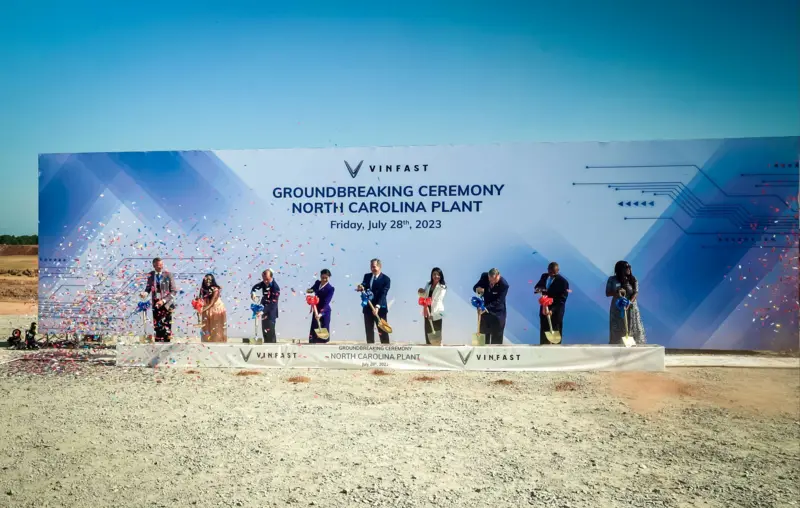
Groundbreaking ceremony for VinFast’s EV plant in Chatham County. Source: https://www.bbc.com/
For example, in Africa, they are planning a 6,300‑hectare large‑scale urban project in Kinshasa, the capital of the Democratic Republic of the Congo. The local government is providing the land for free, and requires the construction of a modern urban centre featuring residences, hospitals, and schools. In India, Vingroup has proposed investing $3 billion to build a smart city in Telangana; in Uzbekistan, they plan to develop a 1,000‑hectare “Vietnam City” in the capital Tashkent, along with electric taxis and charging stations. The expansion is certainly ambitious, but doing projects abroad involves different legal frameworks, and how these plans will actually be executed remains a major challenge.
Trouble in the US plant – tax incentives revoked
Among its overseas operations, the automotive sector is undoubtedly the centrepiece. VinFast has set up branches in Singapore, the US, Germany, and other markets. The most typical example is the electric vehicle factory in North Carolina, USA. This project was once hailed by the former state governor as a “shining jewel.” However, on 22 July, the local Chatham County Commission voted to suspend a $400 million incentive agreement signed with VinFast. The reason: VinFast failed to meet the agreed‑upon timeline.
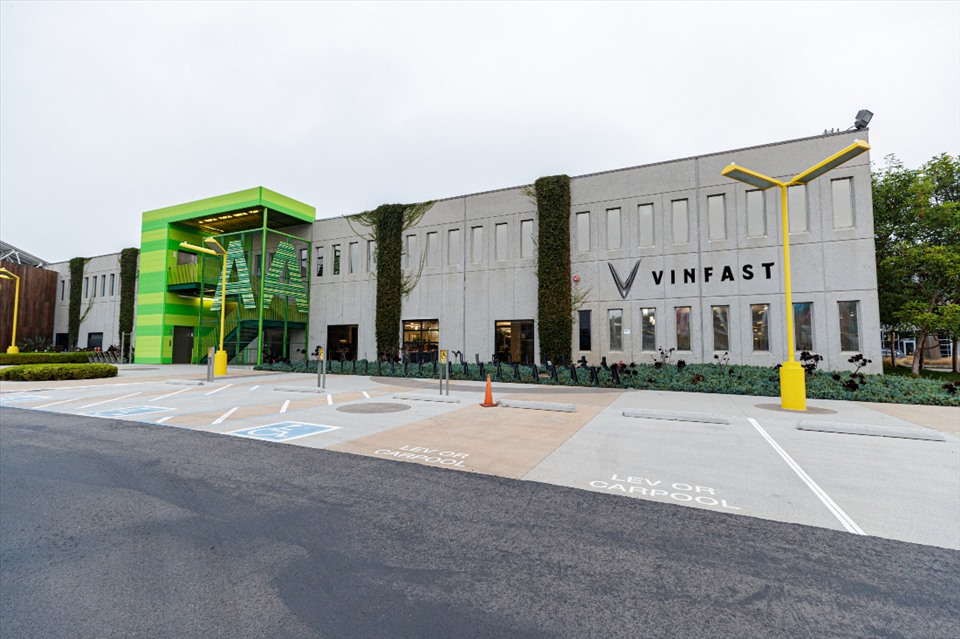
Outside VinFast’s US headquarters in Los Angeles. Source: https://laodong.vn/
As early as May, the North Carolina Department of Justice sued the company for breaching the agreement, demanding that the land be reclaimed through legal means. Looking back to 2022, when VinFast first announced the plant, it made bold promises – a $4 billion investment to produce 150,000 EVs and create 7,500 jobs. To attract them, local authorities offered incentives totalling over $1.2 billion, but these funds would only be released after verifying that the company had actually increased employment and investment.
Major scale‑back and mounting losses
Years later, progress at the US plant has strayed far from the original plan. Production, originally scheduled for 2024, has been postponed to at least 2028. The scale has also been sharply reduced: building floor area was cut from 92,500 square metres to 72,700 square metres, and jobs from 7,500 to 1,400. To make way for the road and factory construction, local authorities had to demolish businesses, homes, and a century‑old church. Local commentators have noted that if the project ultimately fails, it could become one of the region’s biggest economic blunders.
The plant’s setbacks are mirrored by its poor financials. Since announcing the US factory, VinFast has accumulated losses of $9.47 billion over several fiscal years. In the first quarter of 2026 alone, it lost over $1 billion. To lighten the burden, VinFast implemented a major restructuring in May 2026, spinning off its Vietnamese production operations and handing them over to new investors.
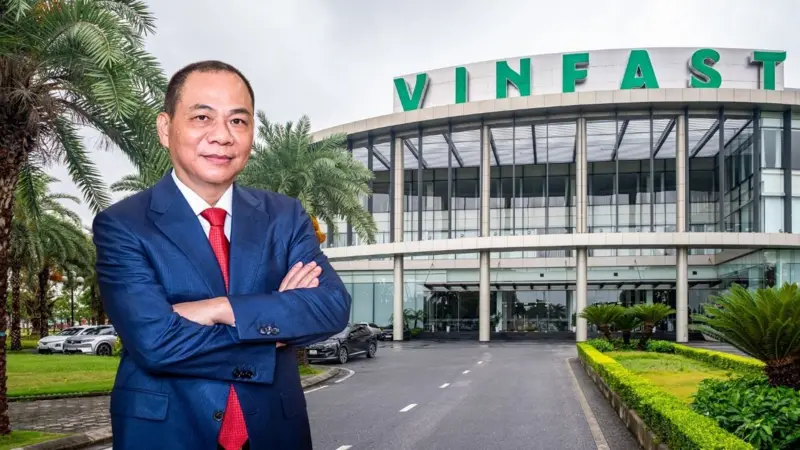
Vingroup founder Pham Nhat Vuong with his EV brand VinFast. Source: https://www.bbc.com/
In short, with Vietnamese real estate cooling and interest rates high, Vingroup’s move abroad to find new profit opportunities was an inevitable step. Whether it is developing a new city on free land in Africa or investing in smart cities in India, the ambition is clear. However, cross‑border business is fraught with challenges – differing local laws, capital costs, and execution hiccups are unavoidable hurdles. In particular, the stoppage, lawsuits, and ever‑growing losses at the US plant add considerable uncertainty to Vingroup’s future.
Want to discuss investment opportunities or related topics in Vietnam? Please contact us:
Tel: +(886) 095 807 2379
Line: vnlandnote
WeChat: vnlandnote
For more updates and insights about Vietnam, please follow us:
Facebook: www.facebook.com/vnlandnote/
WeChat Official Account: hcmc101