From 3 Hours Down to 10 Minutes: A $3.66 Billion Sea-Crossing Project Reshapes Vietnam
From 3 Hours Down to 10 Minutes: A $3.66 Billion Sea-Crossing Project Reshapes Vietnam
Recently, Ho Chi Minh City (TP.HCM) officially approved a massive infrastructure development blueprint that will shake the southern Vietnam region, with an estimated total investment of nearly $7.83 billion (199 trillion VND), focusing on advancing super projects. Among these, the most highly anticipated is the cross-sea channel directly connecting Cần Giờ and Vũng Tàu, with an investment of approximately $3.66 billion (93 trillion VND). From the cross-sea tunnel and the expressway leading directly to the international airport, to the waterfront renovation in the city center, this combination of infrastructure projects led by the Public-Private Partnership (PPP) model indicates that the southeastern region is about to usher in a profound reshuffle of its economic and social landscape. Today, we will break down the development logic behind these major moves and the impacts they will bring.
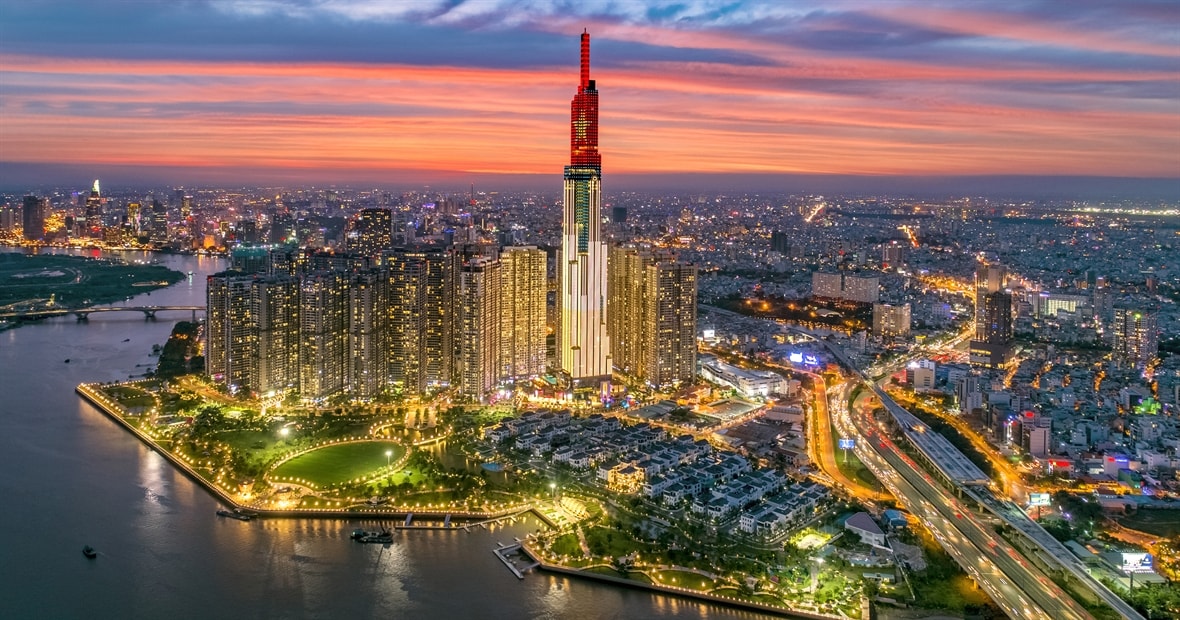
Ho Chi Minh City, image source: diendandoanhnghiep.vn
Crossing Mountains and Seas in 10 Minutes: An Approx. $3.66 Billion (93 Trillion VND) Sea-Crossing Channel Reshapes the Coastal Economic Corridor
For a long time, although Cần Giờ and Bà Rịa – Vũng Tàu are close to each other on the map and both are key towns with strategic status in terms of ports, tourism, and the marine economy, direct transportation between the two places has been extremely inconvenient. Traveling back and forth often requires detouring through long inland highways, consuming a lot of time. The newly approved sea-crossing channel will directly shorten the travel time between the two locations from the current 3 to 4 hours of detouring to just 10 minutes. This preliminary total investment for this sea-crossing super project is approximately $3.66 billion (over 93 trillion VND), with a total length of more than 14 kilometers. According to the plan, the entire route includes a sea-crossing tunnel that is 3.85 kilometers long. The road surface is designed as a spacious 6-lane highway with a maximum speed limit set at 80 km/h, and the overall land and water area used exceeds 169 hectares.

Image source: https://znews.vn/
What is particularly noteworthy is the operation model of this project. The sea-crossing channel adopts a BT (Build-Transfer) contract method. This means that during the construction phase from 2026 to 2029, it will not occupy any national financial funds at all; instead, investors will raise 100% of the funds themselves to carry out the construction. The estimated contract period is 7 years. Once completed, this will not only be a fast commuting line but will also tightly bind Cần Giờ and Vũng Tàu together, forming a golden coastal belt that integrates logistics, tourism, and marine trade, allowing the resources of both places to be exchanged in the most efficient way.
Helping the Resort Capital Take Off: The Expressway from Hồ Tràm Directly to Long Thành Airport (Sân bay Long Thành)
In addition to the sea-crossing channel, another extremely critical transportation artery is the urban expressway connecting Hồ Tràm with Long Thành International Airport (Sân bay Quốc tế Long Thành). Currently, Long Thành Airport is in a full-sprint phase, with the goal of being put into initial operation by the end of this year, according to the instructions of high-level government officials. Long Thành Airport is positioned as a key national infrastructure facility and will play a core role as a regional and even international aviation transit hub in the future. At the same time, Hồ Tràm and its surrounding areas are being built into a high-quality resort tourism and marine economic center. However, the current transportation between the two places mainly relies on an old highway system with its capacity already bottoming out, which completely fails to meet the needs of international tourists who want to reach the seaside resorts quickly after getting off the plane.

Image source: https://znews.vn/
In order to clear this vital meridian for tourism and the economy, Ho Chi Minh City (TP.HCM) has decided to invest approximately $1.85 billion (about 46.918 trillion VND) to build this brand new expressway. The total length of the route is about 42.07 kilometers, which is also planned as a 6-lane highway with a designed top speed of up to 100 km/h. The project is expected to be carried out between 2026 and 2029. Taking environmental protection factors into consideration, the section passing through the Bình Châu – Phước Bửu forest will entirely adopt a viaduct plan to minimize damage to the natural ecology. After the completion of this expressway, it will seamlessly connect with main roads such as the Biên Hòa – Vũng Tàu Expressway, the Bến Lức – Long Thành Expressway, and the Ho Chi Minh City (TP.HCM) Ring Road 4, completely breaking through the development ceiling of the southeastern region.
Bidding Farewell to the Ferry Era: Cần Giờ Bridge (Cầu Cần Giờ) Stitches the Main City Together with the Coastal New Urban Area
For many people commuting between the center of Ho Chi Minh City (TP.HCM) and the Cần Giờ area, the Bình Khánh ferry is often a major pain point of congestion during holidays and festivals. To solve this problem left over from history, the Cần Giờ Bridge project, with its total investment adjusted to approximately $520 million (13.3 trillion VND), has finally entered a stage of substantial advancement. This bridge spanning the Soài Rạp River has a total length of about 7 kilometers, with the middle bridge section measuring about 3 kilometers. Once completed within the next three years, the driving time from the center of Ho Chi Minh City to Cần Giờ will be drastically reduced from the current approximately 1.5 to 2 hours down to 45 to 60 minutes. This is not just a massive saving of time, but it also completely breaks the physical barrier, providing solid transportation support for the development of the Cần Giờ reclaimed urban area.

Image source: https://znews.vn/
To pay for the construction costs of this massive project, Ho Chi Minh City has brought out two pieces of “golden real estate” in the city center worth about $295 million (over 7.5 trillion VND) for exchange settlement, which are the prime plots at 8-12 Lê Duẩn Street and 2-4-6 Hai Bà Trưng Street. The remaining funds will be covered by the city’s financial budget. This flexible land-for-infrastructure model highlights the local government’s determination to promote the outward expansion of the city.
Urban Renewal: Comprehensive Upgrades of Underground Business Districts, Waterfront Parks, and Waterfront Spaces
Besides the drastic transportation infrastructure construction, the old city renovation in the city center is also a highlight of this batch of massive investments. The Bạch Đằng Wharf (Bến Bạch Đằng) and Nhà Rồng Wharf – Khánh Hội (Bến Nhà Rồng – Khánh Hội) areas are about to welcome a transformative major upgrade. At Bạch Đằng Wharf, a section of Tôn Đức Thắng Street will be moved underground to free up space for the construction of a large underground parking lot and commercial center. Above ground, the riverbank will be expanded and green parks will be created to provide citizens with a highly modern waterfront leisure space. And in the Nhà Rồng Wharf area, the Saigon Port (Cảng Sài Gòn) headquarters building will be transformed into a cultural complex integrating offices, graphic exhibitions, and press releases; it will even replicate a historic steamboat model in its original form for tourists to visit. Additionally, Nguyễn Tất Thành Street will be widened to 8 to 10 lanes, and the Tân Thuận 1 Bridge and Tân Thuận 2 Bridge will also be newly built and widened simultaneously. The preliminary total investment for this portion of the waterfront renovation reaches approximately $1.15 billion (29.317 trillion VND).

Image source: https://znews.vn/
Overall, the centralized approval and advancement of these super projects are by no means just as simple as building a few more roads and bridges. From the multi-billion-dollar cross-sea channel to the downtown waterfront upgrades, Ho Chi Minh City is restructuring the underlying logic of the southern economic circle with astonishing boldness. The convenience of transportation will inevitably bring about a rapid flow of population, capital, and industries. The years from 2026 to 2029 will be the critical window period for this land to break out of its cocoon and become a butterfly. For every resident living here, as well as for investors paying attention to the development opportunities in southern Vietnam, a vibrant super metropolitan area is accelerating towards us.
Want to discuss investment opportunities or related topics in Vietnam? Please contact us:
Tel: +(886) 095 807 2379
Line: vnlandnote
WeChat: vnlandnote
For more updates and insights about Vietnam, please follow us:
Facebook: www.facebook.com/vnlandnote/
WeChat Official Account: hcmc101