Vietnam’s GDP per capita is poised to surpass Indonesia’s!
Vietnam’s GDP per capita is projected to reach USD 5,200 in 2026, potentially surpassing Indonesia for the first time and rising to fifth place in Southeast Asia. The government has further raised next year’s target to USD 6,100. Exports, foreign investment, and infrastructure are driving Vietnam’s economic acceleration—how long can this momentum last?
I. The Growth Code Behind GDP per Capita Surpassing Indonesia for the First Time
In 2026, Vietnam’s GDP per capita is expected to reach approximately USD 5,200, higher than Indonesia’s USD 5,100, meaning Vietnam is poised to rank fifth in Southeast Asia by GDP per capita, behind only countries such as Thailand.
Over the past decade, Vietnam’s GDP per capita has nearly doubled. In the first three quarters of this year, Vietnam’s economy grew by approximately 9%, the highest for the same period in nearly 15 years.
Among this, third-quarter economic growth approached 10%, continuing the accelerating trend from the first two quarters.
This wave of growth mainly comes from three directions: continued export expansion, increased investment by foreign enterprises, and the government’s accelerated infrastructure construction.
Particularly in electronics and high-tech manufacturing, Vietnam is attracting more multinational companies to expand production scale.
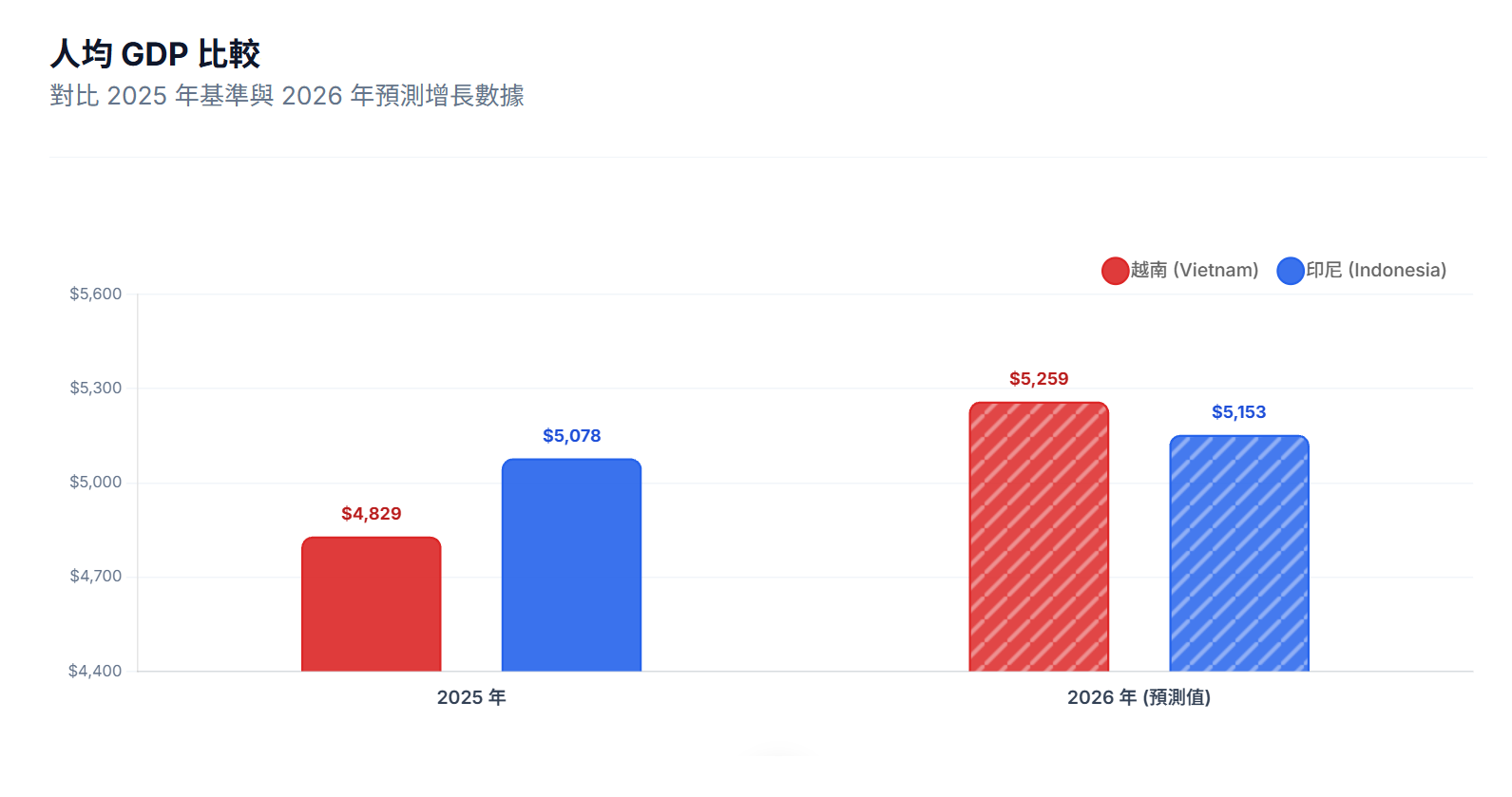 Vietnam vs. Indonesia GDP per Capita Comparison, 2025–2026
The Vietnamese government has even higher expectations for the future.
For 2027, the government has set targets of economic growth of at least 10% and GDP per capita of USD 6,100, and hopes to raise labor productivity by about 8.6%.
By 2030, the government hopes GDP per capita will further reach USD 8,500, approaching Thailand’s current level.
The International Monetary Fund forecasts Vietnam’s economic growth in 2027 at about 7.5%, lower than the government’s target.
This also reflects that in the coming years, Vietnam will need to maintain relatively high investment and production efficiency in order to achieve the planned growth rate.
II. Exports, Foreign Investment, and Infrastructure Accelerating Together
Exports are one of the most obvious drivers of Vietnam’s economic growth this year.
In the first three quarters, merchandise exports reached approximately USD 430 billion, an increase of 25% year-on-year. Total imports and exports for the full year are expected to exceed USD 1 trillion for the first time.
Electronics are an important source of exports.
South Korea’s Samsung Electronics produces mobile phones and other electronic devices in Vietnam, and Taiwan’s Foxconn is also continuing to expand its production footprint in northern Vietnam.
From mobile phone assembly to electronic components and semiconductor-related industries, Vietnam’s participation in the global technology manufacturing supply chain is gradually increasing.
Foreign investment is also accelerating.
In the first three quarters of this year, actually utilized foreign direct investment in Vietnam reached approximately USD 21 billion, an increase of 12% over last year, the highest for the same period in nearly five years.
During the same period, newly registered and additional capital commitments totaled approximately USD 50 billion, growing by more than 75%.
These funds will support the construction of new factories, equipment, and industrial facilities, while also increasing employment and export capacity for Vietnam.

Foreign-funded factories are driving Vietnam’s export growth; the next step depends on whether local suppliers can enter higher-value production stages. Image source: https://vneconomy.vn/
In addition to exports and foreign investment, government investment is also driving economic growth.
In the first three quarters of this year, government budget-supported investment expenditure increased by approximately 19% year-on-year, mainly invested in highways, airports, and other infrastructure.
Vietnam has added approximately 390 kilometers of expressways this year, and the eastern section of the North-South Expressway has also been fully put into use.
Hanoi is simultaneously advancing the construction of five urban railway lines to improve urban traffic and future commuting efficiency.
Accelerated transportation construction directly helps manufacturing.
Transportation between factories and ports is more convenient, which can reduce logistics time and make it easier for enterprises to arrange production and exports.
The government is also addressing investment projects that have long been stalled due to legal, land, or approval issues.
As of the end of September, approximately 4,600 projects have been resolved or proposed solutions. Once some projects resume construction, they will further increase demand for construction, equipment, and related services.

The government is expanding infrastructure investment expenditure, laying the foundation for manufacturing expansion and GDP per capita improvement. Image source: https://vneconomy.vn/
These changes show that Vietnam’s economic growth has formed multiple mutually supporting drivers.
Foreign-funded factory construction drives exports and employment, infrastructure construction improves business operating conditions, and industrial expansion increases demand for logistics, housing, and services.
What Vietnam needs to do next is to involve more local enterprises in this industrial chain.
At present, many high-tech products still rely on imported components and overseas technology. If Vietnamese enterprises can gradually supply components, equipment, and technical services, they can obtain more orders from the expansion of foreign-funded factories and increase the economic value created locally.
III. Five Hundred Tons of Private Gold Reflect Financing Gap
Rapid economic growth has also increased enterprises’ demand for long-term capital.
On October 30, during the National Assembly’s discussion of the economic development plan, a member pointed out that bank credit scale has reached approximately 1.5 times GDP.
Of the funds absorbed by banks, nearly 80% are short-term deposits of less than one year, but about half of loans are medium- and long-term financing.
This means that banks need to continuously absorb short-term funds to support enterprises’ multi-year investments.
 Vietnam’s private sector has accumulated substantial wealth. How to transform it into long-term corporate capital through credible financial markets has become the next topic. Image source: https://kevesko.vn/
Vietnam’s private sector has actually accumulated considerable wealth.
Estimates cited by National Assembly members show that residents hold approximately 500 tons of gold, worth about 12% of GDP.
At the same time, the scale of Vietnam’s corporate bond market is equivalent to 11% of GDP.
These data reflect a problem in Vietnam’s financial market: residents have savings, but enterprises lack sufficient long-term financing channels.
To improve capital circulation, National Assembly members proposed developing pension funds and open-end investment funds.
For Vietnam, expanding the stock, bond, and fund markets will help reduce enterprises’ over-reliance on banks.
IV. Growth Dividends and Local Industry Profit-Sharing Considerations
Amid rapid economic growth, how much practical benefit can Vietnam bring to local enterprises and residents?
In the first three quarters of this year, the average income of Vietnamese workers increased by approximately 9%, but prices during the same period also rose by approximately 4.5%, with housing, utilities, and construction material prices rising by nearly 7%.

Vietnam’s economic scale continues to expand, and GDP per capita is expected to increase, but statistical figures still need to be observed together with residents’ income and living costs. Image source: https://vnexpress.net/
Vietnam has proven its ability to attract foreign investment, expand exports, and accelerate economic growth. In the next stage, the most valuable breakthrough is for more local enterprises to master technology, increase profits, and establish long-term financing channels other than banks. For investors, rather than only looking at GDP growth speed, it is more worthwhile to focus on which enterprises can transform Vietnam’s industrial expansion into sustained revenue and profits.
Want to discuss investment opportunities or related topics in Vietnam? Please contact us:
Tel: +(886) 095 807 2379
Line: vnlandnote
WeChat: vnlandnote
For more updates and insights about Vietnam, please follow us:
Facebook: www.facebook.com/vnlandnote/
WeChat Official Account: hcmc101
-
 November 11, 2026
-
 November 5, 2026
-
 November 4, 2026
-
 October 29, 2026